GDPR and Temporary Email — What You Should Know (Complete Compliance Guide)
Data privacy has become one of the most important legal and technological topics in the modern digital world. As online services increasingly rely on personal data, regulations have been introduced to protect individuals from misuse, tracking, and unauthorized data processing.
One of the most influential privacy laws ever created is the General Data Protection Regulation (GDPR) — the European Union’s comprehensive framework for personal data protection.
At the same time, temporary email services have grown in popularity as tools for privacy, anonymity, and spam reduction.
This raises an important question:
How does GDPR apply to temporary email — and are they compatible?
This guide explains how GDPR regulates email data, how disposable email fits into privacy law, what businesses must consider, and how individuals can use temporary email responsibly under GDPR principles.
What Is GDPR?
The General Data Protection Regulation (GDPR) is a European Union law that governs how personal data is collected, processed, stored, and protected.
It applies to:
organizations located in the EU
organizations outside the EU that process EU residents’ data
This means GDPR has global impact, not just regional relevance.
Core Purpose of GDPR
GDPR exists to give individuals control over their personal information and ensure organizations handle data responsibly.
Key objectives include:
✔ transparency
✔ data protection
✔ accountability
✔ user control
✔ privacy by design
What Counts as Personal Data Under GDPR?
Personal data includes any information that can identify a person directly or indirectly.
Examples:
name
email address
IP address
phone number
location data
online identifiers
Under GDPR, email addresses are personal data if they can identify an individual.
This is critical for understanding how temporary email interacts with GDPR.
What Is Temporary Email?
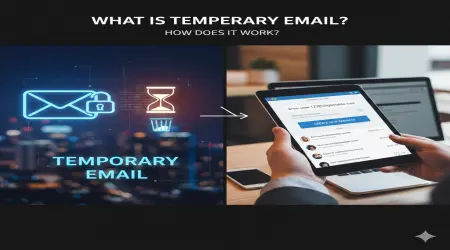
Temporary email (disposable email) is a short-lived email address that automatically expires after a limited time.
Key characteristics:
no permanent account
minimal or no identity connection
automatic deletion
short data retention
Temporary email is widely used for:
protecting privacy
avoiding spam
testing services
anonymous signups
How GDPR Applies to Email Data
Any organization that processes email addresses of EU residents must comply with GDPR requirements.
This includes:
collecting email addresses
storing email databases
sending marketing emails
tracking user activity
sharing email information
GDPR regulates the processing of personal data, not the communication tool itself.
Are Temporary Email Services GDPR Compliant?
Temporary email services are not automatically GDPR compliant — but they can support GDPR principles if implemented correctly.
Compliance depends on how the service:
stores data
handles logs
manages retention
processes user information
A disposable email provider that stores IP logs indefinitely may still process personal data.
How Temporary Email Supports GDPR Principles
Interestingly, temporary email aligns closely with several GDPR privacy principles.
1. Data Minimization
GDPR requires organizations to collect only necessary data.
Temporary email reduces personal data exposure because:
no identity information required
minimal user data stored
short retention period
This supports GDPR’s data minimization requirement.
2. Storage Limitation
GDPR requires data to be stored only as long as necessary.
Temporary email automatically deletes messages — directly supporting this principle.
3. Privacy by Design
GDPR promotes systems designed to protect privacy by default.
Temporary email systems often:
avoid identity linkage
prevent long-term storage
reduce tracking
This aligns with privacy-by-design frameworks.
When Temporary Email May Raise GDPR Concerns
Despite benefits, temporary email can create compliance challenges.
Limited User Identification
Organizations may need verified contact data for:
contracts
security
legal notices
Disposable email may prevent legitimate communication.
Data Controller Responsibilities
Even if users provide temporary email, businesses still must:
justify data processing
maintain records
protect stored information
Temporary email does not remove compliance obligations.
Abuse Prevention
Organizations must prevent fraud and misuse.
Some services block temporary email domains to reduce risk.
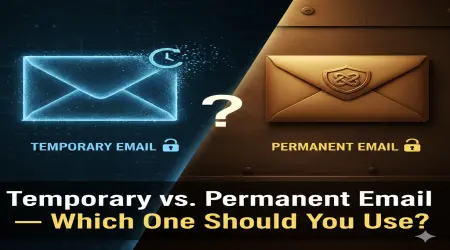
Temporary Email vs Traditional Email Under GDPR
| Factor | Temporary Email | Traditional Email |
|---|---|---|
| Data retention | Very short | Long-term |
| Identity linkage | Minimal | Strong |
| Tracking risk | Lower | Higher |
| GDPR alignment | High (if minimal logging) | Depends on processing |
| Communication reliability | Limited | Stable |
Temporary email supports privacy but reduces long-term communication reliability.
GDPR Rights and Temporary Email
GDPR grants individuals several rights.
Let’s see how they interact with disposable email.
Right to Access
Users can request their data.
Temporary email providers must disclose stored data if identifiable.
Right to Erasure
Temporary email naturally supports deletion.
Auto-expiration satisfies this right.
Right to Data Portability
Less relevant because data often disappears quickly.
Right to Object to Processing
Users may refuse data collection — temporary email helps avoid unnecessary processing.
Real-World Use Cases
Scenario 1 — Privacy-Conscious User
Uses temporary email to sign up for low-trust websites.
GDPR supports minimizing unnecessary personal data sharing.
Scenario 2 — Online Business
Receives temporary email from customer.
Business must still:
protect data
justify processing
maintain compliance
Scenario 3 — Software Developer
Uses temporary email for testing.
No real personal data involved — minimal GDPR impact.
Why Some Companies Block Temporary Email Under GDPR
Blocking disposable email is not required by GDPR, but may be done for risk management.
Reasons include:
preventing fraudulent accounts
maintaining accurate records
ensuring contractual communication
supporting security verification
Companies must balance privacy with operational needs.
Security Implications of Temporary Email Under GDPR
GDPR requires appropriate technical and organizational security measures.
Temporary email providers must consider:
encrypted data storage
limited access controls
secure deletion
breach notification procedures
Short retention alone does not guarantee compliance.
Responsibilities of Temporary Email Providers
To operate responsibly under GDPR, providers should:
✔ disclose data practices
✔ minimize logging
✔ implement security controls
✔ provide transparency
✔ define retention policies
Some providers publish privacy policies explaining data handling.
Cross-Border Data Transfers
Many temporary email services operate globally.
If EU data is processed outside the EU, GDPR cross-border transfer rules apply.
Organizations must use:
adequacy decisions
standard contractual clauses
approved safeguards
Best Practices for Businesses Handling Temporary Email
If users provide disposable email addresses:
✔ treat as personal data if identifiable
✔ maintain consent records
✔ protect stored messages
✔ define retention limits
✔ respect user rights
Compliance depends on processing — not permanence.
Best Practices for Individuals Using Temporary Email
To align with privacy protection:
✔ use for low-risk communication
✔ avoid sensitive data exchange
✔ understand service policies
✔ combine with other privacy tools
Temporary email improves privacy but does not replace security.
Future of GDPR and Disposable Email
As privacy technology evolves, regulators may:
clarify identity verification requirements
regulate anonymous communication more strictly
expand data minimization enforcement
strengthen transparency requirements
However, privacy-enhancing tools are generally supported.
Final Verdict — GDPR and Temporary Email
Temporary email is not prohibited by GDPR.
In fact, it often supports key GDPR principles such as data minimization and storage limitation.
However, compliance depends on how data is processed — not how long it exists.
Organizations must still follow all GDPR obligations, even when interacting with disposable email addresses.
Key Takeaways
✔ Email addresses are personal data under GDPR
✔ Temporary email supports data minimization
✔ Short retention aligns with storage limitation
✔ Businesses must remain compliant regardless
✔ Providers must implement security measures
✔ Disposable email is compatible with GDPR when used responsibly
Conclusion
GDPR and temporary email are not in conflict — they often complement each other.
Temporary email reduces personal data exposure, supports privacy-by-design principles, and helps individuals control how their information is shared online.
However, GDPR compliance depends on responsible data handling, transparency, and security — regardless of whether the email address is temporary or permanent.
Understanding this balance helps both users and organizations operate responsibly in today’s privacy-focused digital environment.